UCF Researcher Leads $1.5 Million DARPA Project to Improve Night Vision, Space Exploration and Healthcare Diagnostics
A University of Central Florida researcher is leading a new, $1.5 million Defense Advanced Research Projects Agency project to develop a highly sensitive infrared imaging system designed to enable improved night vision, space exploration, and healthcare diagnostics.
The project will use a new infrared detection concept based on graphene — a material that is composed of one atom thick regular honeycomb arrangement of carbon atoms.
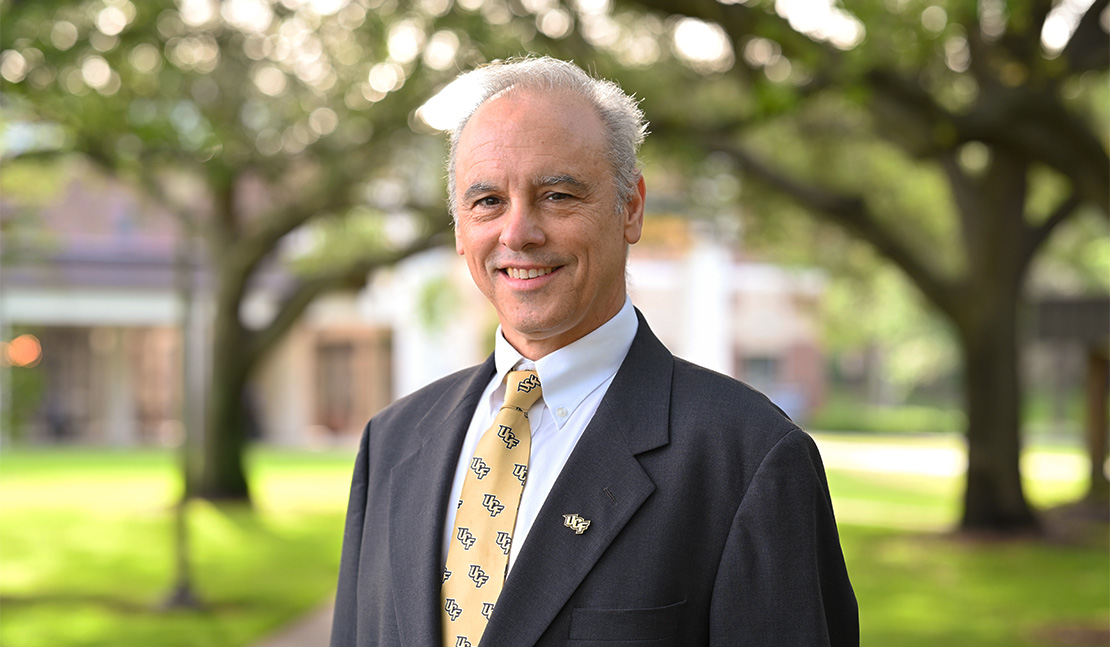
“We could pattern graphene with engineered nano-scale features that work as nano-antennas to collect light-enhancing infrared light absorption by over 30 times compared to the bare graphene sheet,” says Debashis Chanda, the project’s leader and a professor in UCF’s NanoScience Technology Center. “This enables this ‘engineered’ graphene to be used as a light detection material.”
The new imaging system will be more sensitive than current infrared imaging systems and will cost significantly less as it will not require expensive and cumbersome cryogenic cooling.
“A highly sensitive, room temperature infrared imaging system will facilitate many practical applications to emerge,” Chanda says. “The next challenge is to add required electronics to convert this new one-atom-thick material to a functional camera.”
The funding for the three-year, DARPA Direct Phase-II project will be split between UCF and E-Skin Displays Inc., which is a California startup focused on commercializing technologies developed in Chanda’s lab. The main goal of the new grant is to take this new concept to the commercialization domain by transforming it to a functional infrared camera.
This direct Phase II award continues the research and development effort from the previously completed DARPA-funded work.
“Receiving a DARPA Direct Phase-II award is very rare, so I’m feeling quite happy that a challenging agency like DARPA considers my team capable and has confidence in me,” Chanda says.
Chanda has joint appointments in UCF’s Department of NanoScience Technology Center, the Department of Physics, and the College of Optics and Photonics. He received his doctorate in photonics from the University of Toronto and worked as a postdoctoral fellow at the University of Illinois at Urbana-Champaign before joining UCF in Fall 2012.